The artists and artworks displayed on our website represent a curated selection from our full collection, all of which are available for sale at the gallery. For further information, please call us at +44 20 7493 3939 or email paintings@richardgreen.com to inquire or arrange a visit.
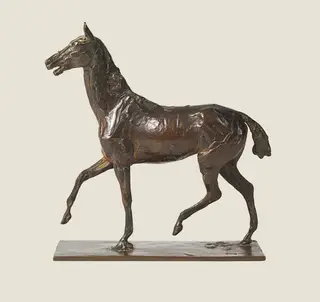
EDGAR DEGAS 1834 - Paris - 1917 Hilaire-Germain-Edgar De Gas was born in Paris on 19th July 1834, into a bourgeois Franco-Italian family. His father Auguste, a banker, was French, and his mother, Celestine, was an American from New Orleans. Branches of the De Gas family in both Paris and Naples had earlier changed the name from Degas in order to denote the ownership of property. However, Degas reverted back to the original spelling around 1870. Having received a classical education at the leading boys’ school Lycée Louis-le-Grand in Paris, Degas embarked on his artistic training at the École des Beaux-Arts as a pupil of Louis Lamothe, a former pupil of Jean-Auguste-Dominique Ingres, whom Degas later met and for whom he developed a considerable admiration. Degas enhanced his training by copying Old Masters in the Louvre, a practice which he maintained until 1870. It was during one of these visits that he first met Edouard Manet. Together with Manet, Monet, Renoir, Sisley, Cézanne and Pissarro, Degas organised the first showing for the Société Anonyme des Artistes, or what is now deemed the first Impressionist Exhibition of 1874. Participating in seven of the eight shows, Degas was a prominent member of the Impressionist group; however, his style, subject matter and artistic sensibility marked his distinction from the other artists. Whilst he shared the Impressionist desire for capturing the fleeting moments of modern life, signalling a radical departure from the outdated modes of the official Salon, Degas did not share their taste for painting en plein air, nor their loose application of paint. He preferred instead to work from his studio and to continue in a style commensurate with his Academic training, which emphasized the use of line and the importance of draughtsmanship. Degas’ fascination for capturing the essence of urban Parisian life came to fruition in his highly inventive yet considered way, primarily through his use of unconventional cropping and precise objectivity, which emphasized the importance of his aesthetic deliberation. His artistic practices were also deeply embedded in the notion that people were created to look at one another. Through this approach, Degas was able to create an idiosyncratic style which has remained popular ever since, particularly his paintings and drawings of café society, horse racing, ballet dancers, concert performers, and women bathing. An innovator in his field, he often set the pace for many of his younger colleagues and is credited with influencing Pablo Picasso, Henri Matisse and the figurative painters Jean-Louis Forain, Mary Cassatt and the English Impressionist Walter Richard Sickert. Following a long career dedicated to a passion for painting, drawing and sculpture, Degas died in Paris on 27th September 1917. His work may be seen in many prominent international collections including the Metropolitan Museum of Art, New York; the Musée d’Orsay, Paris; the State Hermitage Museum, Moscow and the National Gallery, London.
Share

Opening Hours
| Monday - Friday (Except Bank Holidays) |
10am - 5.30pm |
| Saturday | By appointment |
Location
Be the first to know about the latest news, stories, exhibitions, events and much more.
Subscribe